The right string tension is the one that gives you the depth, control and comfort you want with your string, your racquet and your swing. Start inside the range printed on your racquet, change one thing at a time, and judge each change over several sessions. This guide explains what the tension number actually means, how changing it alters the way the ball comes off the strings, and how to test a change properly.
Key points
- The tension you ask for is the pull the machine applies to each string. The tension in the finished stringbed is lower, and it keeps falling after stringing.
- In on-court testing, lower tension sent the ball out slightly faster and at a higher angle (more balls long). Higher tension produced more balls in the net.
- String material changes how firm a given tension feels, so the same number can play very differently with a different string.
- Test one change at a time, with the same string, the same stringer or machine, and notes from several sessions.
- Compare tensions only between setups strung the same way. A number from another shop or another machine is not a like-for-like reference.
What the tension number means
When you ask for a racquet "at 52", you are asking the stringer to pull each string to that reference tension (in pounds or kilograms) before it is clamped. It is an instruction to the machine, not a measurement of the finished racquet. One kilogram is about 2.2 pounds, so check which unit a stringer or a machine is using before comparing numbers.
Racquet makers print a recommended tension range on the frame, usually on the throat or the inside of the hoop. That range is the safest anchor you have, because it is specific to your frame. The middle of it is a sensible first setting if you have no other reference.
Machine pull versus stringbed tension
The tension you play with is lower than the tension you asked for. Physicists Rod Cross and Rob Bower measured strung racquets and found that the tension immediately after stringing was typically about 30% lower than the pull tension, because of stress relaxation in the string, the frame flexing inwards as strings are added, and friction between the strings (Cross and Bower, Sports Engineering, 2001). After that, the tension keeps falling, more slowly.
Two things follow from this:
- The same number does not guarantee the same stringbed. Pull speed, how the frame is mounted, the clamps and the stringer's technique all affect how much of the pull ends up in the racquet. That is why two racquets strung "at 52" in different places can feel different.
- Firmness is not tension alone. What you feel as stringbed firmness depends on the string's stiffness as well as its tension, as Crawford Lindsey's lab work for Tennis Warehouse University points out. A stiff string at a lower number can feel firmer than a soft string at a higher one.
So treat your tension as one part of a recipe: the string, the gauge, the pattern, the reference tension and the way it is strung. If you change who strings your racquet, or what machine they use, expect to adjust.
How tension changes the feel
The clearest on-court evidence comes from a study in which players hit cross-court groundstrokes with racquets strung at different tensions while a radar gun measured ball speed. Lower tension produced slightly faster rebound speeds. It also changed the type of error players made: low tension was more likely to send the ball long, high tension was more likely to put it in the net (Bower and Cross, Journal of Sports Sciences, 2005). The authors put the long balls down to the higher rebound angle off a looser stringbed.
In practice, most players describe the trade-off like this:
- Lower tension: more free depth, a softer and more forgiving feel, and a ball that leaves at a higher angle. Too low and the ball becomes hard to keep in.
- Higher tension: a firmer, more direct feel and a lower, flatter launch. Too high and you have to swing harder for the same depth, and many players find the stringbed less comfortable.
Reading your own errors
Your miss pattern is the most useful clue you have. If your well-struck balls keep landing long and you are not swinging differently, the stringbed may be too loose for you, or it may simply have lost tension since it was strung. If you are hitting cleanly but the ball keeps dropping short or into the net, a slightly lower tension may help. The study above makes the same suggestion: a player who tends to miss in the net could consider a looser setup for more net clearance.
Comfort is personal. If your arm feels worse after you raise tension or switch to a stiffer string, take that seriously and go back to what felt fine.
Tension, string material and string pattern
A tension number only means something next to the string it was used with. In lab tests of 90 strings, Cross, Lindsey and Andruczyk found that strings differ widely in stiffness: when a ball hit a string tensioned to the same starting value, the tension rose by about 9 kg for natural gut, about 18 kg for nylon and about 22 kg for polyester (Laboratory testing of tennis strings, Sports Engineering, 2000). A bigger rise means a stiffer string. That is why many players drop the tension a little when they move from a soft multifilament to a polyester.
| Material | Stiffness in lab tests | What it means for tension |
|---|---|---|
| Natural gut | Lowest of the materials tested | Feels soft at a given tension and holds tension best. |
| Nylon / synthetic gut / multifilament | Middle | A common baseline; a familiar reference when you compare other strings. |
| Polyester | Higher | Feels firmer at the same number and loses tension faster, so players often string it lower. |
For a full comparison of materials, see the tennis strings guide. Thickness also changes feel and durability; that is covered in the string gauge guide.
String pattern and head size
The pattern and head size change how a given tension plays. Fewer, more widely spaced strings (an open pattern such as 16x19) and larger heads generally give a livelier, more forgiving stringbed. Denser patterns (such as 18x20) and smaller heads generally feel firmer and more controlled. This is a general tendency, not a rule, which is another reason to start from the range printed on your own frame rather than from someone else's number.
Temperature
Tennis Warehouse University tests found that cold strings play stiffer and hot strings play softer, and they suggest that if you are stringing just before a match, you string a little lower for cold conditions and a little higher for hot ones (The Effect of Temperature on Tennis String Tension and Stiffness). For most club players this is fine-tuning; get the basic setup right first.
Tension loss: why the number fades
Every stringbed starts losing tension as soon as it is strung. Cross and Bower describe a large drop during stringing and then a slow, steady decline with time, even if the racquet is not used. Lab tests reported by Tennis Warehouse University also show a large drop over the first few hits on a fresh stringbed, after which the loss slows. Polyester loses tension faster than nylon, and natural gut has one of the lowest rates of loss.
This matters for tension choice in two ways. First, a setting that felt right on day one will feel looser a few weeks later, so judge a new tension on fairly fresh strings. Second, if your shots start drifting long with a setup that used to work, the stringbed may simply be tired rather than wrong. For the signs that strings are worn out, how material affects lifespan and how to time a restring, read how long tennis strings last.
How to test a tension change

A tension test is only useful if it isolates tension. Follow the same steps each time:
- Write down your current setup: racquet, string, gauge, reference tension, who strung it and on what machine, and the date.
- Change one thing only. Keep the string, gauge and stringer the same and move the tension by a small step in one direction. If you change string and tension together, you will not know which change you are feeling.
- Play several normal sessions before deciding. One hit on a fresh stringbed tells you little.
- Note the same things after each session: where your misses go (long or net), depth on neutral rallies, how serves land, and how your arm feels.
- Compare at a similar age. Judge the new tension against the old one when both were fairly fresh, not a new stringbed against a worn one.
If you own two identical racquets, string one at your current tension and one at the test tension on the same day and alternate them in practice. That is the fairest comparison you can make.
Keeping the variables fixed
Because the finished stringbed depends on the machine and the technique as well as the number, the most reliable tests come from the same stringer on the same machine, or from stringing your own racquets consistently. A machine whose tension you have checked gives you a stable baseline to compare against. The stringing methods guide explains how pattern and technique choices affect the result.
Frequently asked questions
Should I copy a professional player's tension?
It is rarely a useful shortcut. A tour player's number comes with their own racquet, string, stringer, swing speed and conditions. Because the finished stringbed depends on all of those, the same number in your racquet is unlikely to play the same way. Use their setup as curiosity, not as a target.
Should mains and crosses be strung at the same tension?
Most setups use the same reference tension for both, and that is the simplest place to start. Some players and stringers vary them, especially in hybrids, but treat that as a later, single-variable experiment.
Next step
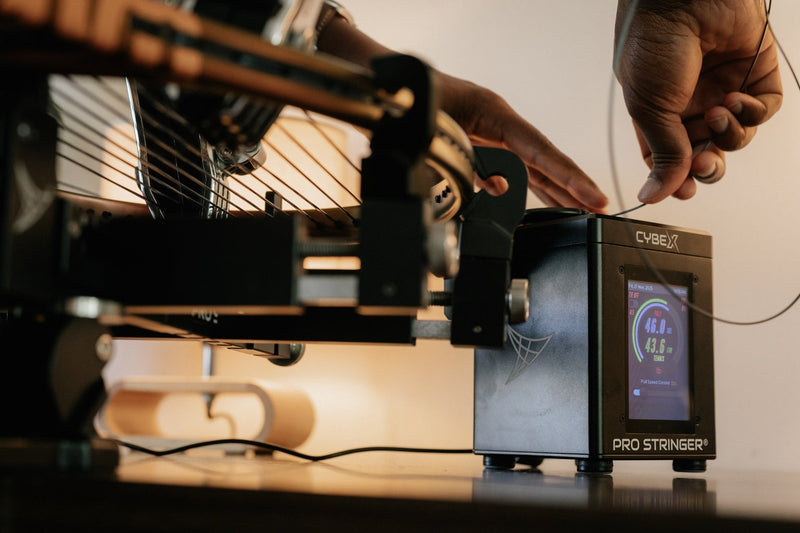
If you want every test to start from the same baseline, stringing your own racquets removes the shop-to-shop variable. The Pro Stringer CybeX is a digital, touchscreen machine that strings tennis, badminton and squash racquets, and you set and repeat the tension you choose. If you only string tennis, compare it with the Platinum 3.0 Tennis.