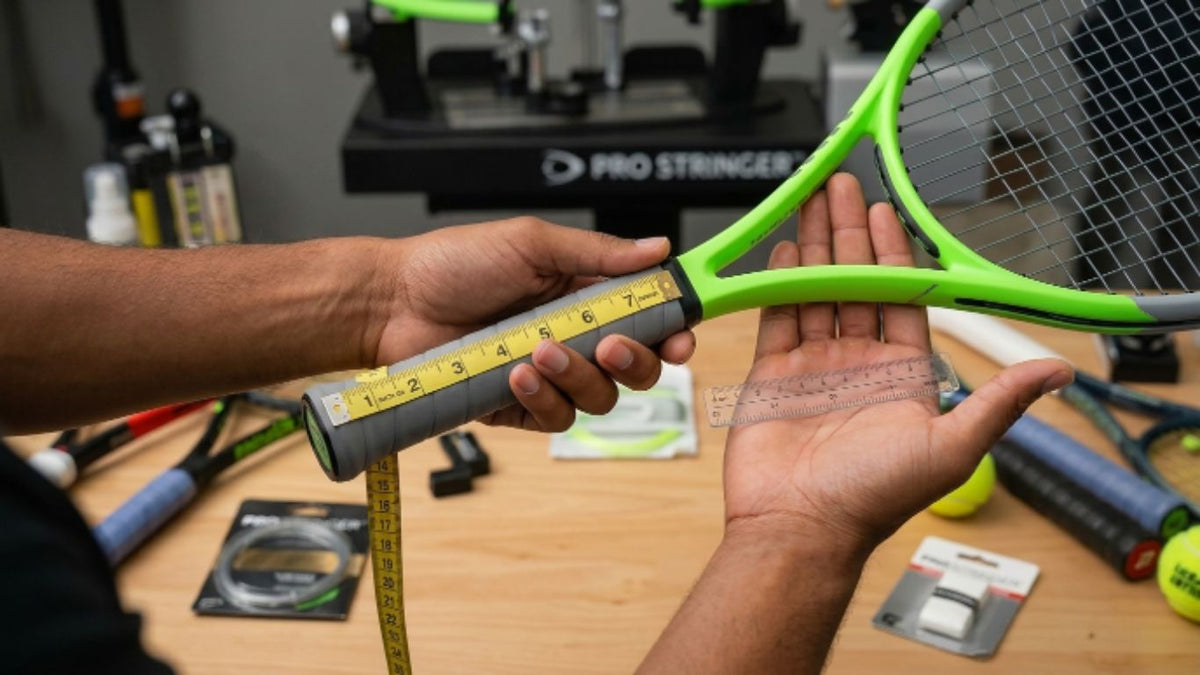
Your tennis grip size is the circumference of the racquet handle. It is printed on the butt cap either in inches (4 to 4 5/8, the US system) or as a number from 0 to 5 (the system used in most other countries), and both describe the same handles. To find your size, start from the racquet you already use, check that your fingertips stop just short of your palm in a handshake grip, and fine-tune with an overgrip rather than buying a bigger handle.
Key points
- Grip sizes 0, 1, 2, 3, 4 and 5 correspond to 4, 4 1/8, 4 1/4, 4 3/8, 4 1/2 and 4 5/8 inches. Each step is 1/8 inch of circumference.
- The quickest fit check is the handshake grip: a little space should remain between your fingertips and your palm.
- If you are between two sizes, both Wilson and Babolat suggest going smaller. A handle is easy to build up but hard to shrink.
- An overgrip adds a small amount of thickness. A heat-shrink sleeve adds a full size.
- Handle shape varies by brand, so two racquets labelled with the same size can still feel different.
Grip size labels: US inches vs European 0–5
The number on the butt cap is a circumference measurement. As Wilson explains, grip sizes are listed in inches in the United States and numbered in most other places, so an end cap that says "3" is the same handle as one marked "4 3/8". Some retailers and racquet listings add an "L" (L2, L3), and that refers to the same scale.
Wilson, Babolat and the Tennis Warehouse Learning Center all publish the same conversion:
| European size | US size (handle circumference) | Babolat hand measurement |
|---|---|---|
| 0 | 4 in | 100–102 mm |
| 1 | 4 1/8 in | 103–105 mm |
| 2 | 4 1/4 in | 106–108 mm |
| 3 | 4 3/8 in | 109–111 mm |
| 4 | 4 1/2 in | 112–114 mm |
| 5 | 4 5/8 in | 115–117 mm |
Tennis Warehouse notes that most adult racquets are sold between 4 1/8 and 4 5/8 inches, and that many models now only go up to 4 1/2. Wilson says 4 1/4 (size 2) is the most common size for women and 4 3/8 (size 3) for men, but adds that you may need something different if your hand is much smaller or larger than average.
Junior racquets are a separate case. According to Wilson, most junior racquets come in one universal grip size. For children, choose by racquet length and pick a grip size only once they move up to an adult frame.

How to check your grip size
Start with the racquet you already have
Look at the butt cap or the throat of your current racquet. The size is usually printed there. If that racquet feels right in your hand, Wilson's advice is simple: stay with that size. Measuring only becomes important when the current handle feels wrong or you have never owned a racquet.
The handshake (finger) test
Hold the racquet with a continental or "handshake" grip, with the base knuckle of your index finger on the top-right bevel (for a right-hander). Wilson's rule is that the handle should be big enough to leave some space between the tips of your fingers and your palm. If your fingers wrap all the way round and run into the base of your thumb, the handle is too small.
Older advice says one finger of your other hand should fit exactly into that gap. Wilson notes that preferences have moved smaller, especially among players who hit with a lot of topspin, and that a smaller grip is fine as long as your fingertips do not touch your palm, even if a full finger will not fit in the gap.
Measuring your hand
If you have no racquet to test, Babolat gives a hand-measurement method. Measure from the tip of your ring finger down to the middle crease of your palm (the second line), then read the matching size from the table above. Babolat's own example: a measurement of 107 mm points to grip size 2. Treat this as Babolat's starting point, not a rule. Then confirm it with the handshake test on a real handle, because handle shape and your grip style also affect the fit.
When you are between sizes
Both Babolat and Wilson say to choose the smaller size when in doubt. An overgrip can enlarge a handle slightly. Making a handle smaller is far harder, or as Wilson puts it, building up is a lot easier than shaving the handle down.
What a poor fit can feel like
None of the following proves your grip is the wrong size, because technique, string condition and fatigue cause similar feelings. Still, many players and coaches use these signs to decide whether a size change is worth testing:
- Possibly too small: your fingertips dig into your palm, you squeeze hard to stop the racquet twisting on off-centre hits, or the handle feels thin when you volley.
- Possibly too large: your fingers feel stretched, changing grips between forehand, backhand and serve feels slow, or the racquet feels clumsy when you try to whip it through for spin.
Change one thing at a time. If you add an overgrip and also restring at a new tension in the same week, you will not know which change made the difference. If the racquet still feels inconsistent after the grip is sorted, check your strings next. The string lifespan guide covers how to tell when a string bed is past its best.
Replacement grip vs overgrip
A tennis handle usually has two layers you can change. They do different jobs.
Replacement grip (base grip)
The replacement grip is the cushioned wrap fitted to the racquet at the factory, wound onto the handle and secured at the top with finishing tape. It sets the basic feel of the handle, including how soft it is and how sharply you can feel the bevels. Replacement grips differ in thickness and cushioning between models, so swapping to a thinner or thicker one is one way to make a small change. Tennis Warehouse lists a grip as adding roughly 4–8 grams with negligible change to balance.
Overgrip
An overgrip is a thin wrap that goes over the replacement grip. Players use it for tack or sweat absorption, and to change it often without disturbing the base grip. Tennis Warehouse estimates that a single overgrip increases grip size by about 1/16 inch, which is roughly half of one size step. Some players use two. Because it is cheap and quick to remove, an overgrip is the easiest way to test whether a slightly bigger handle suits you before you commit to anything permanent.
A common approach is to buy the smaller size and add an overgrip. That way you can go back to the bare handle if you change your mind.
Adjusting your grip size
Going up: heat-shrink sleeves
For a full size increase that keeps the feel of a replacement grip, Tennis Warehouse describes fitting a heat-shrink sleeve. You remove the grip, slide the sleeve over the handle, shrink it in place with a heat gun and rewrap the grip. They state that the sleeve keeps the handle's bevels and can later be sliced off if you want to go back.
A sleeve also adds weight to the handle. Tennis Warehouse puts a full-size sleeve at about 14–16 grams, moving the balance roughly 1/4 to 1/2 inch towards the handle depending on the racquet. Two sleeves are possible but double that weight. If you are fussy about how your racquet swings, have this done by a stringer who can re-check weight and balance afterwards.
Going down
Reducing a handle is limited. You can take off an overgrip or fit a thinner replacement grip. Beyond that, the honest answer is usually a racquet in the smaller size. This is why the "go smaller if in doubt" advice from Wilson and Babolat matters when you buy.
Handle shape
Two racquets labelled with the same size can feel different in the hand. Brands and models vary in how rectangular or rounded the handle is and how pronounced the bevels are. If you are switching brands, try the new handle before you buy, ideally with your usual overgrip on it.

Grip size and the rest of your setup
Grip size controls how the racquet sits in your hand. The strings control how the ball leaves it. When you are chasing a more consistent feel, it helps to keep those variables apart. Settle the handle first with an overgrip test, then look at the string bed:
- For tension, start from the range printed on your racquet and adjust in small steps. See the string tension guide.
- For how often to restring and what changes as strings age, see the restringing guide.
If you string your own racquets, you can keep the string side of that equation identical from one restring to the next. Our stringing machine comparison explains the machine types, and the Learning Center has setup videos for Pro Stringer machines.
Frequently asked questions
Is L3 the same as 4 3/8?
Yes. L3, size 3 and 4 3/8 inches all describe the same handle circumference. The "L" prefix is simply how some sellers write the European number.
Can I use two overgrips?
Some players do, and Tennis Warehouse mentions it as an option. Each overgrip also softens the feel of the bevels. If you need more than one size of build-up, a heat-shrink sleeve under the replacement grip keeps the handle shape more defined.
Should my grip size match my tennis partner's or a pro's?
No. Grip size depends on your hand and how you hold the racquet. Use the handshake test on your own hand rather than copying someone else's setup.