The right tennis string depends on what you want more of: comfort and easy depth, or control and spin when you swing hard. In short, natural gut and multifilament lean towards comfort and power, polyester leans towards control and spin, synthetic gut is the low-cost all-rounder, and a hybrid lets you mix two of them. This guide explains how each material behaves, how strings are built, and how to test a new string so you know whether it actually suits you.
Key points
- String material shapes feel, power, comfort and durability more than most other choices you make after buying a racquet.
- Polyester suits fast, full swings; softer materials suit players who want comfort or help with depth.
- A hybrid puts one string in the mains and another in the crosses, so you can trade off between the two.
- Gauge and tension change how any string plays. They have their own guides, linked below.
- Test one change at a time, at the same tension, over several sessions, before you decide.
The main tennis string materials
Most strings sold today belong to one of four material families. Within each family there is a wide spread between brands and models, so treat the descriptions below as typical tendencies rather than fixed rules.
| Material | Typical feel | Typical strengths | Typical trade-offs |
|---|---|---|---|
| Natural gut | Soft, lively, elastic | Comfort, power, holds tension well | Highest price, sensitive to moisture |
| Synthetic gut (nylon) | Medium | Low cost, decent all-round playability | Does not stand out in any one area |
| Multifilament | Soft, cushioned | Comfort and feel closest to gut | Can feel vague to some players; wears faster for big hitters |
| Polyester (mono) | Firm, low-powered | Control, spin, durability | Stiffer on the arm; playability fades as tension drops |
Natural gut
Natural gut is made from cow intestine and is the material other soft strings try to imitate. Tennis Warehouse's string materials guide describes it as offering excellent playability and keeping its tension very well, while being the most expensive option. It is also sensitive to moisture: Babolat, for example, packs its natural gut in foil to protect it from light and moisture until it is strung. Gut suits players who value feel and comfort and are willing to pay for it.
Synthetic gut
Synthetic gut is typically made of nylon. It is the budget choice: reasonable playability for the price, without excelling at comfort, spin or durability. It is a sensible baseline if you are new to the game or want a reference string to compare others against.
Multifilament
Multifilaments bundle hundreds of fine fibres into one string, which gives a softer, more cushioned response. They are the usual choice for players who want gut-like comfort at a lower price. The trade-off is durability: players who hit with heavy topspin tend to saw through them faster, and some players find the response less precise than polyester.
Polyester
Polyester (often called "poly", and in blended forms "co-poly") is the dominant string at professional level. It is firm and low-powered, which lets fast swingers take full cuts without the ball flying long. The same guide notes that polyester loses tension faster than other materials and is harsher on the arm, so it is generally not the first choice for beginners or anyone with elbow or shoulder sensitivity.
Hybrids
A hybrid uses one string for the mains (the vertical strings) and another for the crosses. The most common pairing is polyester with a softer string such as multifilament or natural gut, aiming to keep some of polyester's control while softening the feel. Which string goes where matters: many players find the string in the mains has the bigger say in how the racquet feels, so swapping the two can change the result noticeably.
How string construction changes the feel
Material is only part of the picture. How the string is made also affects how it behaves.
Monofilament versus multifilament
Most polyesters are monofilaments: one solid strand. Multifilaments and many synthetic guts are built from many fibres, sometimes around a central core. As a broad tendency, many-fibre strings feel more cushioned and wear faster, while solid polyester strands feel firmer and last longer.
Shape, texture and coatings
Many polyesters are made with a shaped cross-section (for example five-, six- or eight-sided) or a textured surface, marketed as giving more "bite" on the ball. The evidence here is more modest than the marketing. Lab work published by Tennis Warehouse University concluded that a string with more grip on the ball is likely to produce more spin, but "perhaps not always and probably not a great deal more". Many strings also carry a coating, often marketed as helping the strings slide over each other.
Why slippery strings matter for spin
Tennis Warehouse University's spin potential research explains that when string-to-string friction is low, the main strings slide along the crosses and snap back, and that the ideal combination is high friction against the ball and low friction between strings. Their string movement videos showed polyester strings moving farther, and in more places, than gut or nylon. That helps explain why polyester is linked with spin. The same work also stresses that how you swing and how the ball arrives affect spin more than small differences between strings do.
Choosing a string by your priorities
Rather than choosing by player level, start with the one thing you most want to fix or improve. Then pick the material that leans that way, and accept the trade-off it brings.

If comfort is the priority
Look at natural gut, multifilament, or a hybrid with a soft string in the mains or crosses. If you currently use a full bed of polyester and your arm is complaining, a softer material is a more direct change than any other adjustment.
If you keep hitting long
A firmer, lower-powered string, usually a polyester, gives fast swingers more margin. If you are not a fast swinger, polyester may simply make the ball land short and feel harsh, so this is a choice for players who generate their own pace.
If you want more spin
Polyester is the usual choice because its strings tend to move and return during impact. Shaped or textured polyesters may add a little. Swing speed and technique still matter more than any string.
If you keep breaking strings
Polyester is the most durable material for most players, and a thicker version of the same string lasts longer. Our tennis string gauge guide explains how thickness affects durability, feel and spin.
If budget matters most
Synthetic gut is the low-cost starting point. A hybrid can also stretch the life of an expensive string, for example by pairing a gut or multifilament with a cheaper polyester.
How to test a new string properly
Strings are hard to judge in one hit. A new string bed feels different from a worn one regardless of the material, so a fair test needs a bit of structure.
Change one thing at a time
Keep the racquet, tension and gauge the same and change only the string. If you change the string and the tension together, you will not know which change you are feeling. Start from the tension range printed on your racquet or recommended by the manufacturer; our tennis string tension guide covers how to adjust from there.
Compare like with like
If you can, string two identical racquets: one with your current string as a reference and one with the new string. Swap between them during the same session. If you only have one racquet, compare the new string with notes you made on your old setup when it was at a similar age.
Give it several sessions
Judge the string after a few sessions, not on the first day. Note the same things each time: depth, how often you miss long or into the net, spin on your normal shots, comfort in your arm, and how quickly the feel changes. Writing a line or two after each session makes the comparison far more reliable than memory.
Watch how it ages
Some strings feel great when fresh and fade quickly; others are steadier. How long a string keeps its feel is part of the result. Our guide to how long tennis strings last covers the signs that a string bed has gone dead.
Keep the rest of the setup consistent
A string test is only fair if each restring is done the same way. Different stringers and machines can produce different results from the same requested tension, which makes it hard to tell whether the string or the string job changed. Stringing your own racquets on a well-maintained machine is one way to remove that variable; our tennis racquet restringing guide covers what a good string job involves.
Frequently asked questions
Is polyester bad for your arm?
Polyester is stiffer than other materials and is generally described as harsher on the arm. Many players use it without problems, but if you have elbow or shoulder discomfort, a softer material or a hybrid is a sensible thing to try.
Which way round should a hybrid go?
The most common setup is polyester in the mains and a softer string in the crosses, which keeps more of polyester's control. Many players find that putting the soft string in the mains gives a softer, livelier feel. Try one, keep notes, then try the other.
Does Pro Stringer make its own strings?
Yes. Pro Stringer Strings are polyesters, Blue Steel and Silver Bullet, each sold in two diameters listed in millimetres. Test them the same way as any other string: one change at a time, at a tension you already know.
Your next step
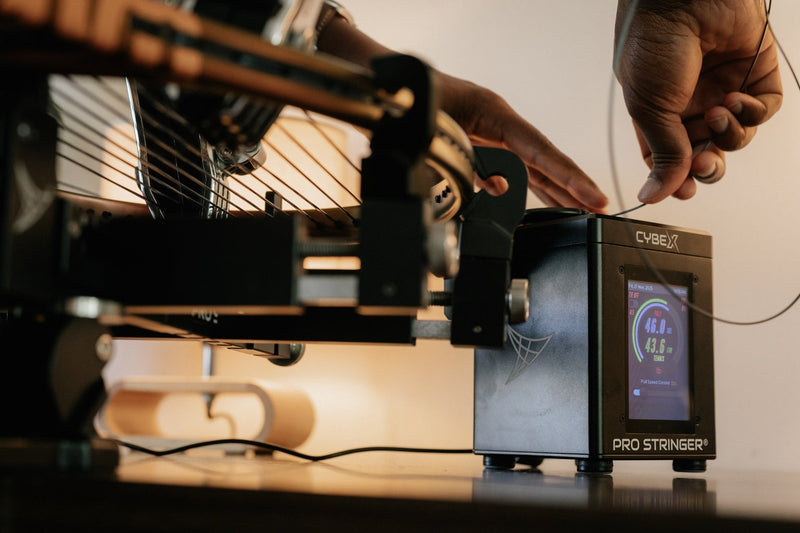
Pick the priority that matters most to you, choose one string that leans that way, and run a simple test over a few sessions. If you string your own racquets, the Pro Stringer Learning Center has step-by-step videos, and the Pro Stringer CybeX is our digital, touchscreen machine that strings tennis, badminton and squash racquets.