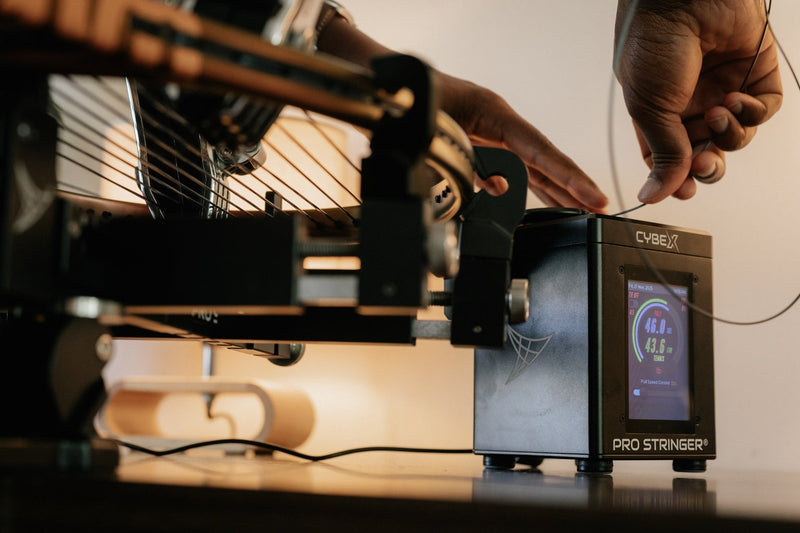
Stringing machines differ in four main ways: how they pull tension (drop weight, crank lockout or electronic constant pull), how they hold the frame (2, 4 or 6 mounting points), how they hold tension while you work (fixed or flying clamps), and whether you can take them with you. There is no single best type. The right machine depends on how many racquets you string, which sports you string for, where you will use it, and how much consistency you need from one string job to the next.
Key points
- Drop-weight, crank (lockout) and electronic (constant-pull) machines can all produce good string jobs when used well. They differ in speed, ease of use and how they handle string stretch.
- Mounting points spread the load on the frame during stringing. More points generally means more support but slower mounting.
- Fixed clamps sit on the machine. Flying clamps sit on the strings. Each has trade-offs.
- Portability means more than weight. Check what you need to clamp it to, whether it needs mains power, and how it packs.
- Before buying, check the tension range and mounting for every sport you string, along with support, warranty and how to check calibration.
Tensioning: how each machine pulls the string
The tensioner is the heart of the machine. Gamma Sports, a long-standing stringing machine manufacturer, describes three tensioning methods and makes a point worth keeping in mind throughout: all three can produce top-quality string jobs when used correctly. The stringer's technique matters as much as the mechanism.
Drop weight
A weighted bar on a hinged arm pulls the string. You slide the weight along the bar to set the tension, then level the arm. Drop-weight machines are mechanically simple and need no power. The weight keeps pulling while the bar is level, so string stretch is taken up as long as you keep it level. Gamma notes that they are less user-friendly than the other types but attract people who are just starting out. Many stringers find them slower, because the bar has to be levelled on every pull.
Crank (lockout)
You turn a crank and the tension head draws the string back. When the set tension is reached, the mechanism locks. This method is usually quicker than drop weight and needs no power. Because the head stops pulling once it locks, any stretch that happens before you clamp is not taken up by the machine. That is the difference constant pull was designed to remove. Results depend on the operator, so pause briefly and clamp consistently.
Electronic constant pull
A motor pulls the string to the set tension and, in Gamma's description, "continues to pull as the string stretches to maintain tension until the string is clamped". The main benefits are that the machine repeats the pull the same way every time and you need little physical effort. In return, it needs electricity, the electronics add parts that may need servicing, and the tension reading is only as good as the machine's calibration.
| Method | How tension is applied | Takes up string stretch before clamping | Needs power | Main trade-off |
|---|---|---|---|---|
| Drop weight | Gravity on a weighted bar | Yes, while the bar is kept level | No | Slower; levelling the bar is a skill |
| Crank lockout | Manual crank, locks at set tension | No, stops pulling at lockout | No | More dependent on operator timing |
| Electronic constant pull | Motor pulls until the string is clamped | Yes | Yes | Relies on electronics and calibration |
Mounting systems: 2, 4 and 6 points
The mounting system holds the frame while the strings are pulled. Each "point" is a place where the machine touches the frame. Gamma's summary is that a 6-point mount offers more stability and helps prevent frame distortion, while a 2-point mount is quicker to set up and leaves fewer obstacles for the string to catch on. A 4-point mount sits between the two.
The number of points also interacts with how the tensioner works. On a conventional machine, the tension head sits some distance from the frame, and the mount has to resist that pull across the whole racquet. Pro Stringer machines take a different approach. The tensioner presses directly against the frame (or against the butt cap for the centre mains), and Pro Stringer says this places a symmetric load on the frame, which is why it offers a 2-point option. If you are unsure, more support points are the cautious choice, particularly for older, thin-beamed or delicate frames.
Pro Stringer's mounting system, ModuleX, comes in 2-, 4- and 6-point versions. It fits both CybeX and Platinum 3.0, and the configurations can be changed later. The ModuleX comparison shows the three side by side.

Clamps: fixed vs flying
Fixed clamps
Fixed clamps are attached to the machine, usually on swivelling bases that glide under the racquet. Gamma notes that because they are anchored to the machine there is less chance of them slipping, and their range of motion helps when you string many different patterns. They are typically found on larger, higher-volume machines.
Flying clamps
Flying clamps are not attached to the machine. They grip two or more adjacent strings, using one string to hold tension on the next. Gamma describes them as less consistent and less expensive. Pro Stringer machines use flying clamps by design, since there is no turntable for fixed clamps to ride on. Pro Stringer's Claws are shaped to keep the clamped strings parallel, and the Claws 3.0 can hold two or three strings. If you choose a flying-clamp machine, learning to seat the clamp close to the frame and at the same angle every time is part of getting consistent results.
Portability and power
Gamma frames the first decision as table-top versus stand-up. Ask yourself where you will string, how much space you have, and whether the machine needs to travel to tournaments. Some practical checks:
- What it attaches to. Table-top machines need a sturdy surface. A machine that clamps to a table edge has a maximum thickness it can grip. The ModuleX table clamp, for example, has a 70 mm clamping range.
- Power. Drop-weight and crank machines need none. Electronic machines need mains power, and a power supply that accepts different voltages matters if you travel abroad.
- Packing and flying. Pro Stringer packs its machines in a travel bag and says they can be taken on board as cabin luggage. Sharp tools such as the awl, pliers and cutters should go in checked bags.
- Setup time. A portable machine you have to assemble each time is only convenient if setup is quick. Watch a full setup video before you buy.

Where Pro Stringer's machines fit
Both Pro Stringer machines are compact electronic constant-pull tensioners that work at the frame with flying clamps. That puts them in a different category from a conventional table-top or floor-standing machine. The two models differ mainly in controls and in how many sports one machine covers:
- CybeX is digital. It has a touchscreen and a top display, settings for specific sports, and Wi-Fi firmware updates. One CybeX strings tennis, badminton and squash.
- Platinum 3.0 sets tension with a knob and has no digital features. It is sold as separate sport-specific models for tennis, badminton and squash, each with the tension range, mounting and clamps for that sport. If you string for more than one sport, you need a Platinum package for each.
The honest trade-offs: you need a table to clamp to and a power socket, and you will be working with flying clamps rather than fixed ones. If you string a high volume of racquets in a shop, a full-size fixed-clamp machine may suit your workflow better.
What to check before you buy
- Your sports. Confirm the tension range, mounting and clamps suit every racquet you will string, including badminton or squash if needed.
- Your volume. A few racquets a month and a dozen a week call for different machines. Higher volume favours speed of mounting and clamping.
- Where it will live. Check whether you have a permanent bench, a kitchen table or a hotel desk. Measure the surface the machine clamps to.
- Calibration. Tension readings can drift with use. Ask how the machine is checked and adjusted, and whether a calibration tool is available.
- Support and warranty. Find out who you contact when something breaks, how parts are supplied, and whether instructional videos exist for your exact model.
Whichever machine you choose, the bigger gain usually comes from stringing the same way every time. The stringing methods guide covers patterns and techniques, and the tension guide covers choosing a starting tension.
Frequently asked questions
Is a crank machine accurate enough for a club player?
It can be. Gamma's view is that all three tensioning methods produce good results when used correctly. With a lockout machine, consistency comes from the operator. Pull at the same speed, wait the same time and clamp the same way on every string.
Does a 2-point mount damage racquets?
On a conventional machine, fewer support points means the frame carries more of the load unsupported, which is why many shop machines use 6 points. Pro Stringer's design braces the tensioner against the frame itself, which is its stated reason for offering 2 points. If you string older or delicate frames, choosing more support points is the cautious option.
Can one machine string tennis, badminton and squash?
Some can, provided the tension range, mounting and clamps cover each sport. CybeX covers all three in one machine. Platinum 3.0 is sold per sport.