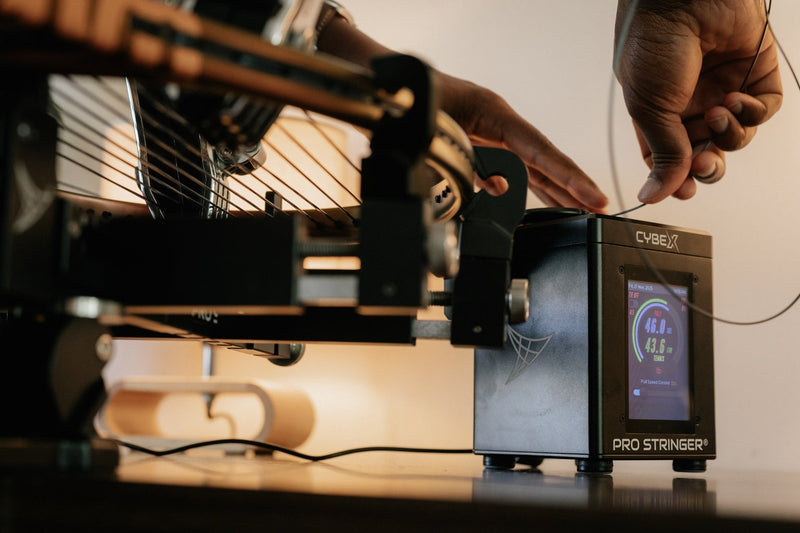
Big Time Tennis tested an early Pro Stringer machine in July 2016. The review is useful because it records both what a professional stringer liked about a compact electronic machine and what got in the way when moving from a large workshop machine.
What the reviewer liked
The author liked the machine overall and saw it as a practical option for travelling players: a small electronic constant-pull tensioner, a table-mounted swivel mount, two flying clamps and a worldwide power supply in one bag.
What the reviewer criticised
- Measured with a scale, the tensioner reached the 55 lb reference and then fell back to about 50 lb.
- The finished stringbed measured lower than on the reviewer’s workshop machines; he attributed part of that to calibration and part to his own unfamiliarity with flying clamps.
- Clearance between the frame mounts and the stringbed made weaving crosses awkward.
- He wanted easier tension adjustment and more room under the cross brace.
These are observations from one test of a 2016 model. They are not a measurement of today’s CybeX or Platinum 3.0, and they should not be quoted as an accuracy endorsement either way.
What a buyer can learn from the test
Judge the whole stringing workflow, not only the size of the machine: mounting access, clamp handling, the space for weaving, and how you will check tension. Compare jobs by measuring the same way each time and keeping notes.
Pro Stringer’s current range starts with CybeX, a digital machine that strings tennis, badminton and squash racquets, and Platinum 3.0, which is sold as sport-specific models. The Learning Center shows each machine’s setup and stringing sequence on video.
Original source
Read the original review (Big Time Tennis, 11 July 2016). The full review belongs to its publisher; this page summarises it and links to it.